NPP RAISES CONCERNS OVER NATIONWIDE SHUTDOWN OF GHANA HEALTH SERVICE DIGITAL SYSTEMS

By Mackenzie Blankson
Official NPP News & Communications Contributor
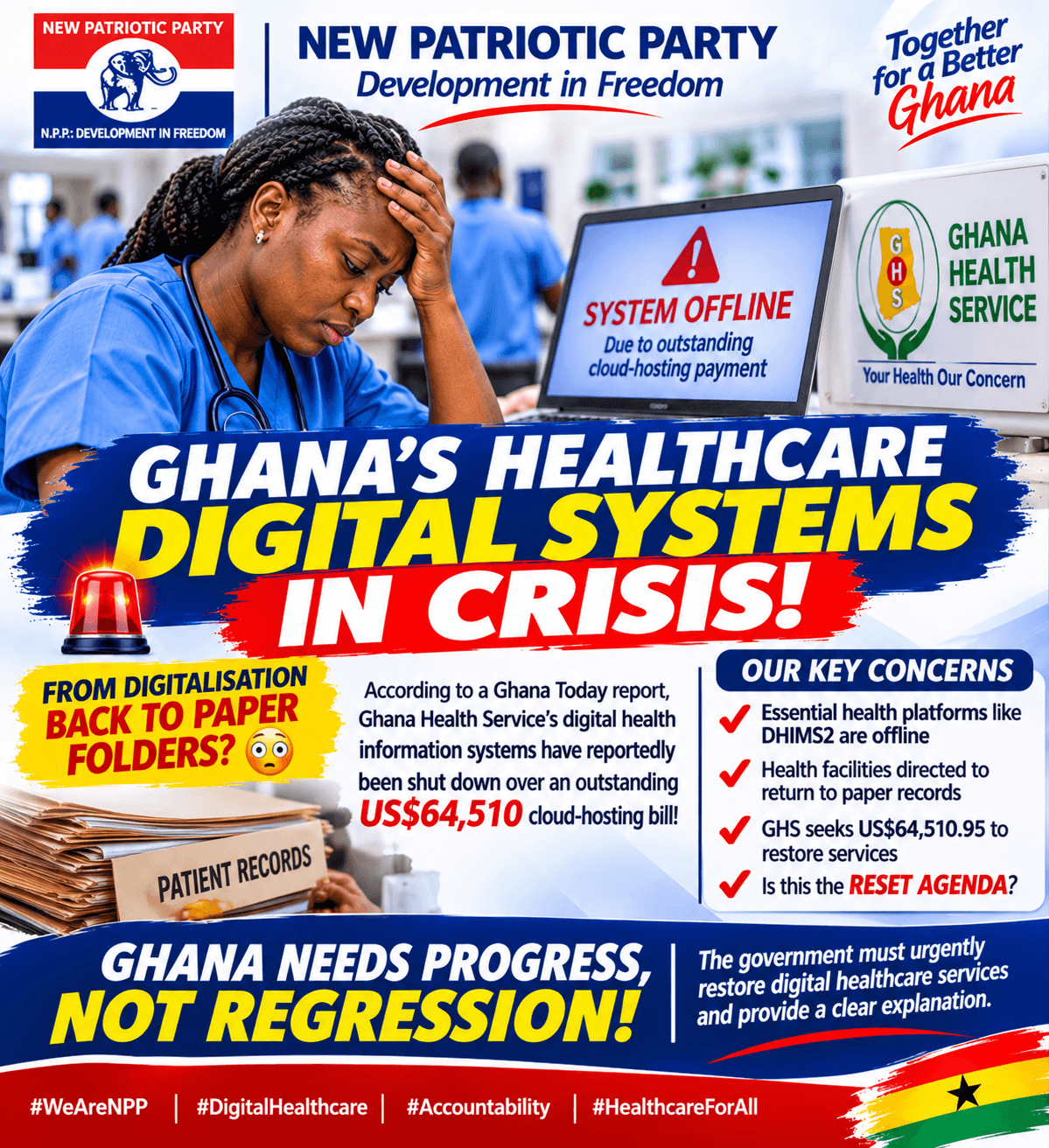
Party calls for urgent government action as health facilities return to paper-based reporting following cloud-hosting disruption
The New Patriotic Party (NPP) has raised concerns over reports that the Ghana Health Service (GHS) has suspended access to several of its electronic health information systems nationwide following the shutdown of its cloud-hosting servers over an outstanding payment of approximately US$64,510.95.
The disruption, which reportedly began on October 29, 2026, has affected the District Health Information Management System (DHIMS2), Ghana’s national health information reporting platform, alongside several other digital systems used by health facilities and administrators across the country.
The development has renewed public discussion about the sustainability of Ghana’s digital healthcare infrastructure and the government’s responsibility to ensure that essential technology supporting healthcare administration remains operational.
Several Digital Health Platforms Affected
According to reports based on an internal memorandum issued by the Director-General of the Ghana Health Service, Dr Samuel Kaba Akoriyea, the hosting provider deactivated all ten servers supporting the affected platforms.
Among the systems affected is DHIMS2, which supports the entry, validation, analysis and extraction of national health data.
Other affected platforms include the Planning and Budget Management Information System (PBMIS), eTracker, the Family Planning and Health Care platform, HIV and tuberculosis trackers, the National Malaria Data Repository and the Non-Communicable Disease tracker.
The disruption has also affected the data-exchange gateway responsible for transmitting birth notifications to the National Identification Authority and the Births and Deaths Registry.
Although some Android applications remain functional offline, their web-based services and integration with other systems have been disrupted.
Health Facilities Directed to Return to Paper Records
In response to the shutdown, the Ghana Health Service has directed health facilities and district offices to temporarily maintain paper-based records and reporting procedures.
Facilities have been instructed to continue completing registers and monthly summary forms to preserve health information for October and November. The records are expected to be entered into DHIMS2 once access is restored.
The directive highlights the importance of maintaining continuity in health reporting, even as the affected digital platforms remain unavailable.
GHS Seeks US$64,510.95 to Restore Services
The Director-General disclosed that the Service is pursuing approval for a payment of US$64,510.95 to reinstate its existing account with cloud-hosting provider Akamai.
According to the reported memorandum, settling the outstanding amount would allow the affected systems to be restored to their previous state without rebuilding them.
An alternative option would involve procuring new servers and reconstructing the systems using existing backups. However, that process could take up to six weeks after the necessary server capacity has been secured.
Dr Akoriyea has appealed to the sector minister to support efforts to expedite the approval process.
He also assured health officials that the shutdown had not resulted in a security breach or loss of data, explaining that encrypted backups were maintained outside the suspended account and were current as of October 29, 2026.
Questions Over Ghana’s Digital Healthcare Agenda
The development raises important questions about the long-term management, financing and reliability of Ghana’s digital public services.
The NPP believes that the reported disruption deserves urgent attention from government, particularly given the growing role of technology in healthcare administration, health data management and the coordination of public health services.
The incident also brings renewed attention to the government’s much-publicised digitalisation and RESET AGENDA commitments, with questions about the measures being taken to protect critical public-sector technology infrastructure from avoidable service interruptions.
For a country investing in digital transformation, the reliability of essential health information systems must remain a priority.
Call for Urgent Action and Long-Term Solutions
The immediate priority must be the restoration of the affected systems and the prevention of further disruption to health-sector operations.
Government and the relevant authorities must also provide clear information on the circumstances that led to the shutdown, the steps being taken to settle the outstanding payment and the expected timeline for restoring the affected platforms.
The Ghana Health Service has indicated that, after services are restored, it intends to consider a carefully managed migration to a Ghana-based hosting provider. The proposed transition would include parallel operations and a properly funded backup arrangement.
The NPP maintains that Ghana’s healthcare system must continue moving towards reliable, secure and sustainable digital services rather than face prolonged interruptions to essential infrastructure.
Healthcare information systems are an important part of modern healthcare delivery. Their uninterrupted operation, proper funding and long-term sustainability must therefore receive the attention they deserve.
#WeAreNPP #DigitalHealthcare #GhanaHealthService #Digitalisation #Accountability #Healthcare
Listen to the Analysis
The Future Infrastructure Podcast: Episode 42
Sustainable Resilience
Beyond connectivity, the plan emphasizes ecological stewardship. By integrating smart-grid technology with regional solar arrays, the goal is to achieve energy independence while reducing the national carbon footprint by 30% over the next decade. The ripple effect on the manufacturing sector is expected to be profound, as lowered energy costs attract high-tech production.
format_quote“True progress is measured not by the height of our buildings, but by the breadth of the opportunities we create for every citizen.”
— President J.A. Kufuor (2004)