NPP Closes Filing of Nominations for 2026 National Officers Elections

By Mackenzie Blankson
NPP Editorial Contributor



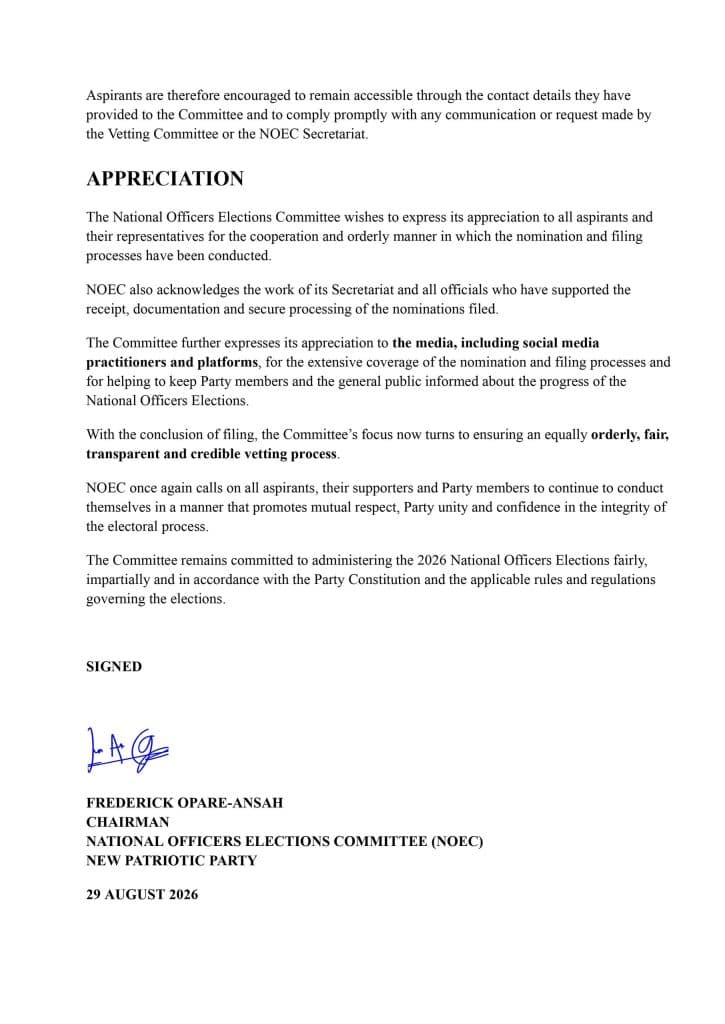
The National Officers Elections Committee (NOEC) of the New Patriotic Party (NPP) has officially closed the filing of nominations for the 2026 National Officers Elections.
According to a press statement issued on Saturday, 29 August 2026, the filing of nominations officially closed at 6:00 p.m., with a total of forty-seven (47) aspirants successfully filing their completed nomination forms with the Secretariat.
The Committee noted that a total of fifty (50) persons had earlier purchased nomination forms to contest for the various National Officer positions. However, three aspirants did not complete the filing process by the deadline.
The aspirants who will not proceed to the next stage are Mr. Bernard Antwi Boasiako, who formally communicated his decision to withdraw his candidature for the National Chairperson position; Mr. Evans Kodom, who stepped out of the contest for the National Communications Director position; and Ms. Perpetual Ekua Lomokie Akwada, who did not present her completed nomination forms for filing by the close of nominations.
The NOEC will now proceed to the next major stage of the electoral process—the vetting of the forty-seven (47) aspirants who duly filed their nominations.
The vetting exercise will commence on Monday, 31 August 2026, and end on Thursday, 3 September 2026, with the various positions scheduled for vetting on designated days.
The Committee will communicate specific details regarding the date, time, venue, and other requirements for the appearance of each aspirant before the Vetting Committee through their designated official communication channels.
The NPP remains committed to ensuring a transparent, credible, and well-organised process as the Party continues preparations for the 2026 National Officers Elections.


Listen to the Analysis
The Future Infrastructure Podcast: Episode 42
Sustainable Resilience
Beyond connectivity, the plan emphasizes ecological stewardship. By integrating smart-grid technology with regional solar arrays, the goal is to achieve energy independence while reducing the national carbon footprint by 30% over the next decade. The ripple effect on the manufacturing sector is expected to be profound, as lowered energy costs attract high-tech production.
format_quote“True progress is measured not by the height of our buildings, but by the breadth of the opportunities we create for every citizen.”
— President J.A. Kufuor (2004)