12 Traffic Offences Motorists Must Know Under Ghana’s TraffiTech-GH System

By Mackenzie Blankson
Official NPP News & Communications Contributor
The introduction of the TraffiTech-GH automated traffic enforcement system has brought renewed attention to road safety and the need for motorists to comply with Ghana’s road traffic laws.
Under the system, cameras, sensors and other enforcement devices are deployed to detect traffic violations, with the aim of improving road discipline, reducing accidents and protecting lives.
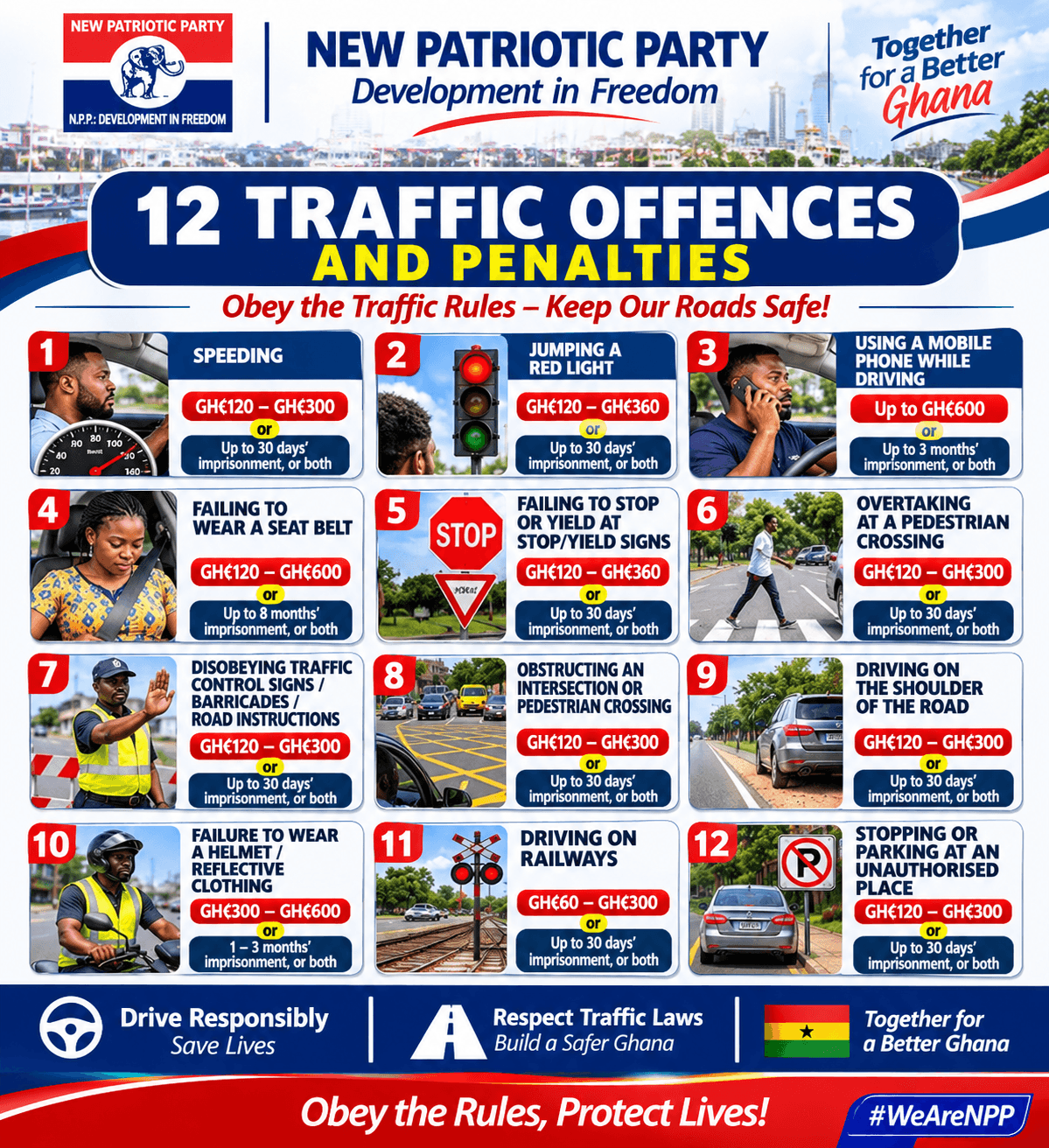
An infographic published by Channel One TV has highlighted 12 traffic offences and their associated penalties under Ghana’s road traffic regulations, serving as an important reminder to drivers, motorcyclists and other road users about their responsibilities.
The 12 Traffic Offences and Their Penalties
The offences highlighted include:
- Speeding: Exceeding prescribed speed limits, attracting fines of GH₵120 to GH₵300 or up to 30 days’ imprisonment, or both.
- Jumping a red light: Disobeying traffic signals, attracting fines of GH₵120 to GH₵360 or up to 30 days’ imprisonment, or both.
- Using a mobile phone while driving: Operating a phone while behind the wheel, attracting a fine of up to GH₵600 or up to three months’ imprisonment, or both.
- Failure to wear a seat belt: Driving without wearing the required seat belt, attracting fines of GH₵120 to GH₵600 or up to eight months’ imprisonment, or both.
- Failure to stop or yield at STOP/YIELD signs: Ignoring mandatory road signs, attracting fines of GH₵120 to GH₵360 or up to 30 days’ imprisonment, or both.
- Overtaking at a pedestrian crossing: Overtaking vehicles at designated pedestrian crossings, attracting fines of GH₵120 to GH₵300 or up to 30 days’ imprisonment, or both.
- Disobeying traffic control signs, barricades or road instructions: Ignoring lawful traffic directions and control measures, attracting fines of GH₵120 to GH₵300 or up to 30 days’ imprisonment, or both.
- Obstructing an intersection or pedestrian crossing: Blocking intersections or pedestrian crossings and disrupting the free movement of traffic, attracting fines of GH₵120 to GH₵300 or up to 30 days’ imprisonment, or both.
- Driving on the shoulder of the road: Using the road shoulder improperly, attracting fines of GH₵120 to GH₵300 or up to 30 days’ imprisonment, or both.
- Failure to wear a helmet or reflective clothing: Motorcyclists failing to use the required protective equipment, attracting fines of GH₵300 to GH₵600 or one to three months’ imprisonment, or both.
- Driving on railway lines: Violating railway crossing regulations, attracting fines of GH₵60 to GH₵300 or up to 30 days’ imprisonment, or both.
- Stopping or parking at an unauthorised place: Parking or stopping vehicles where it is prohibited, attracting fines of GH₵120 to GH₵300 or up to 30 days’ imprisonment, or both.
Understanding the TraffiTech-GH System
The Ghana Police Service says TraffiTech-GH is designed to improve compliance with road traffic laws through automated monitoring and enforcement.
When an offence is detected and validated, an Electronic Notice of Violation (ENV) is issued to the registered vehicle owner or, in applicable roadside cases, the driver.
Motorists who receive an electronic notice are expected to review the evidence and either pay or contest the notice within 14 days. Failure to pay within the stipulated period attracts an additional daily penalty.
The Police have also provided an online platform through which motorists can review evidence and manage their notices.
Road Safety Is a Shared Responsibility
The enforcement of traffic regulations should not be viewed solely as a means of imposing fines but as an essential measure to protect lives and promote responsible behaviour on Ghana’s roads.
Drivers must exercise caution, obey traffic signals, respect pedestrians, avoid distractions and ensure that their vehicles meet the required safety standards.
The New Patriotic Party believes that effective road safety management requires not only enforcement but also public education, transparent administration and the provision of safe and accessible road infrastructure.
As Ghana continues to strengthen its road traffic enforcement framework, all road users are encouraged to familiarise themselves with the regulations and play their part in making the country’s roads safer.
Road safety is everyone’s responsibility. Let us obey the rules, protect lives and make Ghana’s roads safer.
#WeAreNPP #RoadSafety #TraffiTechGH #SafeRoads
Listen to the Analysis
The Future Infrastructure Podcast: Episode 42
Sustainable Resilience
Beyond connectivity, the plan emphasizes ecological stewardship. By integrating smart-grid technology with regional solar arrays, the goal is to achieve energy independence while reducing the national carbon footprint by 30% over the next decade. The ripple effect on the manufacturing sector is expected to be profound, as lowered energy costs attract high-tech production.
format_quote“True progress is measured not by the height of our buildings, but by the breadth of the opportunities we create for every citizen.”
— President J.A. Kufuor (2004)